An owner-compiled examination of the public record
What Glenmont's recorded documents establish, and where they go silent
Different documents do different jobs, and most confusion here comes from treating them as one. Broadly, there are two tracks: covenants written into the deeds, and a corporation formed later to hold the common ground, joined by a single 1986 assignment. Some documents reach all four Areas; some reach only three, and which one controls a question changes the answer. The pages that follow take them one at a time:
One example of the kind of question the record settles cleanly is how a covenant violation may be enforced. Every Area's Exhibit A gives a single remedy:
"… the sole remedy therefor … shall be a proceeding to enforce compliance."
A court proceeding (not a fine, and not a lien) is the remedy for a covenant or architectural violation. The identical clause is verified in Areas 1, 2/3, and 4.
Source · Area 1 Exhibit A, Liber 813, folio 214. See How covenants are enforced.
This is research compiled by a homeowner from public records. It is not legal advice, and it is not a directive to ignore anyone. Its purpose is to lay the documents out plainly so you can verify them and, if it matters to your situation, take them to your own attorney or title company.
02 · The stakes
Why this matters to you
These documents are not just paperwork. They decide real things about the home you own: whether you need permission to change a fence, a door, a roof color, or to build an addition; whether you have to accept a "no"; what happens if you go ahead without approval; who has to take care of the common ground behind your lot, and who pays for it; and what you owe in dues.
What this site does not say matters too. It does not claim the HOA has no real role, and it does not tell you to stop paying your dues. It just lays out what the recorded documents actually say, so you can check any request against the source instead of taking someone's word for it.
1. Which document does this rule or duty actually come from?
2. Who can enforce it, and how?
03 · Origins
How Glenmont was created
The root deed
The tract passes from Duncan & O'Neill to Colonial Corner Service Corporation, the developer entity at the head of the chain.
Duncan & O'Neill → Colonial Corner Service Corp · Liber 685, folio 562The covenants are written into the deeds
For each Area, title passed out and back (through The Drew Company), and on the way back the restrictions were attached as the deed's Exhibit A. This is the moment the covenants, and each Area's Architectural Review Committee, were created.
Area 1 established
Area 1's deed and Exhibit A are recorded. The Exhibit A is the entire governing regime for Area 1; there is no separate Declaration.
Deed Liber 813, f. 208 · Exhibit A 813, ff. 211–220The corporate Association comes into being
The Glenmont Homeowners' Association is incorporated, adopting its By-Laws the next day, on a separate corporate track. Neither document grants architectural authority over the lots.
Articles of Incorporation (Apr. 7) · By-Laws (adopted Apr. 8, 1978)Areas 2 & 3 established
The Areas 2/3 deed and Exhibit A are recorded, together with a freestanding Declaration carrying the common-area duties and the assessment lien.
Deed Liber 877, folio 658 · Exhibit A & Declaration, 877 seriesArea 4 established
Area 4's deed (55 lots across Blocks C, D, and J) and Exhibit A are recorded; Area 4 adopts the Declaration by a supplemental instrument.
Deed Liber 917, f. 44 · Exhibit A 917, f. 49 · Supplemental Declaration 917, f. 41The one bridge: the Assignment of Rights
General Services Corporation, successor to Colonial Corner, assigns the developer's ("Grantee's") Exhibit A rights to the HOA. This single instrument is the only recorded connection between the deed covenants and the Association.
Liber 1476 · folio 7 (Areas 2/3) · folio 10 (Area 1) · folio 13 (Area 4)Then the record goes quiet
The Exhibit A requires every successor ARC committee member to be seated "by a duly executed and recorded instrument." From 1986 forward, across roughly four decades, the record shows a sustained absence of the activity the governing documents contemplate:
- One successor ARC appointment ever recorded (Area 1, 1977), and none in any Area since.
- No architectural or covenant instrument of any kind recorded for the committees.
- No charter amendment since 1985 on the Association's SDAT filing history.
- The Association was forfeited by the State twice, in 1980 and again in 1992, and left forfeited from October 1992 until a revival in March 2013: more than twenty years.
Whether one reads the land records or the corporate filings, the picture across forty years is the same. See Architectural authority.
Howard County Land Records · SDAT filing history, ID D00871913The same story, illustrated as a relationship map
The timeline shows when. This shows who holds what over whom: the two tracks the developer set in motion, and the single assignment that bridges them.
Color shows what each thing is: green for parties, gray for the recorded instruments, red for the ACC, a body the By-Laws name but never defined or appointed. The one amber link, the 1986 Assignment, is the only bridge between the two tracks.
04 · The key
The governing instruments: a map
Deed Exhibit A 813 · 877 · 917
Covenant track · runs with the land"Restrictions Imposed on Lots," attached to each Area's deed. This is where the covenants (use, setbacks, architectural review, fences, nuisance) actually live, and where each ARC was created. There are three separate Exhibit A's, one per Area group, each binding only its own lots and each amendable only by its own owners.
The Declaration Areas 2/3/4 only
Corporate/common trackA freestanding covenants instrument for Areas 2, 3, and 4. It carries the common-area maintenance duties and the assessment obligation with its lien. Area 1 has no Declaration. Its Exhibit A stands alone, which sets Area 1 apart from the others: its architectural and use covenants apply, but the Declaration's common-area duties and assessment lien were never recorded against it.
Articles of Incorporation corporate charter
Corporate trackBrings the Glenmont Homeowners' Association into existence as a corporate body and states its purposes. It does not, by itself, create architectural authority over the lots.
By-Laws Art. IX · Art. XI
Corporate trackThe Association's internal rules. Article IX directs the Association to appoint an Architectural Control Committee "as provided in the Declaration" (never implemented); Article XI carries the assessment lien for unpaid dues.
The 1986 Assignment Liber 1476 · ff. 7,10,13
The single bridgeTransfers the developer's Exhibit A rights: narrow successor-appointment and court-enforcement, to the HOA. Folio 7 covers Areas 2/3, folio 10 Area 1, folio 13 Area 4. It is the HOA's only recorded link to the covenant regime.
The Common Area deed Liber 917 · folio 67
Common propertyConveys six common-area parcels in fee simple to the HOA. Ownership of the common ground, and the duties that come with it, trace here and to the Declaration. See The Common Properties.
There is no one "Glenmont covenant." There are three Exhibit A's and (for 2/3/4) a Declaration. A statement that is true for one Area may be false for another, and each Area's owners hold their own vote to amend or cancel their own Exhibit A.
05 · The corporate body
The Association & assessments
A corporate body
The Association exists by its Articles of Incorporation and operates under its By-Laws. It is the entity that holds the common parcels, maintains them, and administers assessments. None of that is in question here.
Membership
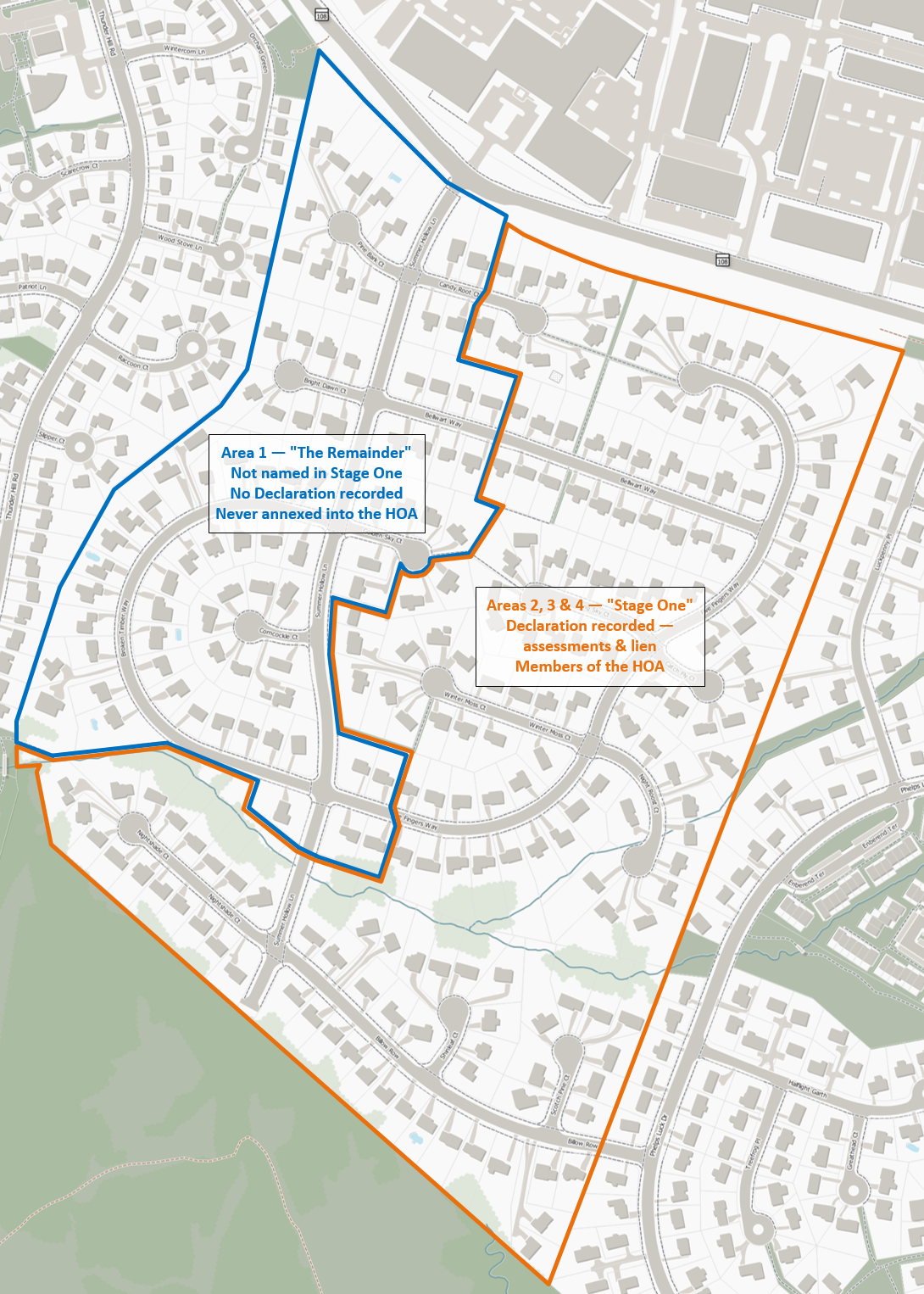
Membership is not simply "everyone in Glenmont." The Articles define members in two halves: owners of lots in Stage One, and owners in any part of the Remainder later brought within the Corporation's jurisdiction. Which side of that line a lot sits on decides everything, and that is exactly where Area 1 becomes a question.
Why Area 1 is outside the Association
Area 1's covenants predate the Association and route through no Declaration, so whether Area 1 belongs to the Association turns on a single document: the Association's own charter. And by the charter's own definition of who its members are, Area 1 is left out. The Articles were filed April 7, 1978, more than a year after Area 1's covenants were recorded (February 22, 1977). Timing alone would not settle anything; associations often form after their covenants. But the Articles do something more specific: they define the community in two halves and place Area 1 on the far side of the line.
"A Class A Member shall be a record owner holding title to one or more lots laid out in Stage One of Glenmont Community, or in any part of the Remainder of Glenmont Community brought within the jurisdiction of the Corporation."
"Stage One" is enumerated by three named plats: Area 2 (Plats 3972 and 3973) and Area 3 (Plat 3771). Area 1 is not among them; it falls in the "Remainder." The Articles gave the developer one way to bring Remainder lots in: it could annex them "without the consent of any of the members," but only "within seven (7) years of the date of the Declaration." The Declaration is dated April 10, 1978, so that window closed on April 10, 1985. No annexation of Area 1 appears in the record, within that window or after.
Source · Articles of Incorporation (filed April 7, 1978), membership article
Membership is also tied straight to assessment: it is "appurtenant to … ownership of any lot which is subject to assessment by the Corporation," and the assessment power is exercised "pursuant to the terms of the Declaration." The By-Laws agree: membership runs to those "entitled to membership … as provided in the Declaration." Every path back to membership runs through the Declaration or an annexation, and Area 1 has neither of record.
Area 1's Exhibit A binds the land to its architectural and use covenants; that is settled, and it runs with the land regardless of the HOA. But Association membership and assessment are a separate track, and on the instruments reviewed there is no recorded step placing Area 1 within Stage One, subjecting it to the Declaration, or annexing it "within the jurisdiction of the Corporation." On the record, Area 1 falls outside the charter's membership definition.
Assessments and the lien
"As more fully provided in the Declaration, each member is obligated to pay … assessments which are secured by a continuing lien upon the property against which the assessment is made."
Unpaid assessments are secured by a lien. This is the Association's one self-executing money remedy, and it is limited to assessments. Note the opening words: the By-Laws point to the Declaration as the source of that lien.
Source · By-Laws, Article XI
Assessments in Areas 2, 3, and 4, and the Area 1 gap
The assessment lien is real, and for Areas 2, 3, and 4 it sits in a recorded instrument: the Declaration. There, each lot is "subjected by covenants of record to a lien for charges and assessments," each assessment becomes "a charge on the land and a continuing lien upon each of the Lots," and the Association may foreclose that lien. Area 4 adopts the same Declaration. For those Areas, the lien has a clear recorded home.
"… shall be a charge on the land and a continuing lien upon each of the Lots against which each such assessment is made …"
This is where the assessment lien actually lives: the "Covenant for Assessments." The By-Laws quoted above do not create it; they secure assessments "as more fully provided in the Declaration," pointing back to this instrument as the source. (The foreclosure remedy is §8.)
Source · Areas 2/3 Declaration, Article V (Covenant for Assessments), §1, foreclosure remedy at §8; adopted by Area 4.
Area 1 has no Declaration, and its Exhibit A contains no lien, assessment, dues, or charge provision of any kind. So the recorded instrument that creates the assessment lien in Areas 2/3/4 has no Area 1 counterpart. The By-Laws still obligate members to pay "as more fully provided in the Declaration," but for Area 1 there is no Declaration for that phrase to point to: the same structural gap as the never-implemented ACC.
Voting, the board, and amending the governing documents
Four governance mechanics are worth reading straight from the instruments: who may vote, who may serve, and how easily each of the two corporate documents can be changed.
Voting is one vote per lot, and it belongs to members
"Each Class A Member shall be entitled to one vote per lot, for each such lot owned by such member, in all proceedings in which action shall be taken by members of the Corporation."
One vote per lot, held by Class A Members; non-members do not vote. The same Stage One / Remainder line that governs membership governs the vote.
Source · Articles of Incorporation, membership article
The board, and its officers, need not be members
"The affairs of this Association shall be managed by a Board of five (5) directors, who need not be members of the Association."
This one runs the other way, and it belongs here for honesty. Directors, and therefore officers, need not be members, so an Area 1 owner serving on the board, or as President, is expressly permitted whatever Area 1's membership status.
Source · By-Laws, Article IV §1; officer requirement, Article VIII §1
The By-Laws are the easiest instrument to change, and the weakest
"These By-Laws may be amended, at a regular or special meeting of the members, by a vote of a majority of a quorum of members present in person or by proxy …"
A quorum is only one-tenth of the votes of each class, so a relatively small share of members can amend the By-Laws. But the By-Laws sit at the bottom of the hierarchy: the Articles and the Declaration both control over them, and no By-Laws amendment can create or enlarge architectural authority, which lives in the deed Exhibit A.
Source · By-Laws, Article XIII (Amendments) §§1–2; quorum at Article III
The Articles take a supermajority to change
"Amendment of these Articles shall require the assent of seventy-five percent (75%) of the entire membership."
The charter is the opposite: amending it takes seventy-five percent of the entire membership, not a majority of a small quorum. So the document that draws the boundary around Area 1 is the hardest one to change.
Source · Articles of Incorporation, Eighth
Neither the Articles nor the By-Laws grant the Association architectural authority over the lots. That authority lives only in the deed Exhibit A. And the assessment lien secures dues, not compliance: it is not a remedy for architectural or covenant violations. See How covenants are enforced.
06 · The Exhibit A regime
What the covenants require
The main subjects, by theme
Each Exhibit A is organized into numbered paragraphs. Rather than reproduce them line by line, here is what they cover: permitted use of the lots; building location and setbacks; architectural review (its own subject, see The architecture instruments); fences and walls; and nuisance restrictions on noxious or offensive activity. These are ordinary residential covenants, and they bind whether or not the HOA is involved.
They run with the land, and bind successors
The restrictions attach to the lots, not to the original buyers, and pass to every later owner. They were made part of the consideration for the deeds and are, by their terms, enforceable by and against successors, a point that becomes important on the enforcement page.
Duration: a renewing thirty-year term
The covenants ran for an initial thirty years from recording and then renew automatically in ten-year increments unless cancelled. For Area 1, recorded in 1977, that initial thirty-year term has already passed, which is what makes the cancellation right below a present, not hypothetical, power.
Amendment & cancellation: a per-Area vote
"… any of the provisions … numbered 1, 2, 3, 5, 6, 7, 8, 9 and 10, may be cancelled, annulled, or abrogated, in whole or in part, by the recording … of an … instrument … executed by the then record owners of a majority of the above described lots …"
Cancellation is by a majority of "the above described lots", the lots subject to that Exhibit A. With three Exhibit A's, each Area votes on its own, and can reach a different result. This is a power the owners hold directly; it does not run through the HOA. Put plainly: if a majority of the owners in an Area want to cancel one or more provisions, they may do so by a majority vote.
Source · Area 1 Exhibit A, Liber 813, folio 218
07 · Authority & its limits
How the covenants are enforced
Who may enforce
"… enforceable by the Grantor or Grantee, their respective successors and assigns, and by any person or party then owning … any lot subject hereto, against anyone violating or attempting to violate any of said restrictions …"
Enforcement is not the HOA's alone. As assignee of the Grantee, the HOA holds a right to enforce, but so does any lot owner. Neighbors may enforce these covenants against neighbors.
Source · Area 1 Exhibit A, paragraph 11, Liber 813, folio 218
The remedy is a proceeding: at law or in equity
"… or in equity, and such proceedings may be to enforce any covenant … to restrain violation thereof, or to recover damages for breach of same."
The instrument's remedy is a lawsuit: to compel compliance, enjoin a violation, or recover damages. Nowhere does the Exhibit A create a fine, a penalty, or a lien for breaking a covenant.
Source · Area 1 Exhibit A, paragraph 11, Liber 813, folio 219
For architectural review specifically, the same, expressly
"… the sole remedy therefor under the provisions of paragraph numbered 11 hereof shall be a proceeding to enforce compliance."
The architectural paragraph points straight back to paragraph 11 and calls it the sole remedy. If ARC approval is required and not obtained, the instrument's answer is a compliance proceeding, not a fine or stop-work penalty. The identical language appears verbatim in the Exhibit A for Areas 2/3 and Area 4.
Source · Liber 813, folio 214 (Area 1); identical in Areas 2/3 and Area 4
Where the lien comes from
The only lien in these documents is a different mechanism entirely. It secures unpaid assessments, money owed as dues, and lives in the Declaration (Article V, "Covenant for Assessments") and the mirroring by-laws article. It is not a remedy for covenant or architectural violations and cannot be stretched into one. See The Association & assessments.
For an architectural or covenant violation, these instruments let the HOA, or any neighbor, do one thing: go to court. There, a judge can be asked to enforce compliance (order the owner to follow the covenant), to enjoin the violation (order it stopped or undone), or to award damages (money for the harm it caused). What they never allow is for the HOA to act on its own: it cannot fine your account or put a lien on your home without a court. A real power, but a courtroom one.
08 · The central finding
Architectural authority
Three deed-defined ARCs, and the members really differ
Each Exhibit A names its own three-member Architectural Review Committee. Two names recur, but the third seat differs, so these are three separately-constituted committees, not one Association-wide body:
Area 1 (813): Robert E. Hecht · Thomas J. Reynolds · Leonard C. Gore (replaced 1977 by Ferdinand P. Kelly)
Areas 2/3 (877): Robert E. Hecht · Thomas J. Reynolds · Parker F. Heckner
Area 4 (917): Robert E. Hecht · Thomas J. Reynolds · Parker F. Heckner
Gore did not stay long. He resigned in October 1977, and Colonial Corner Service Corporation appointed Ferdinand P. Kelly in his place by a recorded Deed of Appointment (Liber 858, folio 168). Note the mechanism: a resignation, an appointment by the party holding the power, and a recorded instrument. That is exactly what the covenants require, and 1977 is the last time the record shows it happening.
Source · the ARC clause in each Exhibit A · 813/214 · 877 · 917 · Deed of Appointment 858/168
Fixed at three, changed only on the record
Each ARC is fixed at three members. The power to change the membership is split: a broad power held by a majority of that Area's lot owners, and a narrow death-or-resignation power held by the developer (the Grantee). Both require "a duly executed and recorded instrument."
What the 1986 assignment moved, and what it didn't
The assignment transferred the Grantee's Exhibit A rights to the HOA: the narrow death-or-resignation appointment power and the enforcement standing. It did not transfer the owners' broad power to reshape a committee, and it did not create any new architectural authority. The HOA's connection runs to the smaller of the two powers, in each Area.
Two other bodies that are not the deed ARC
The ACC
An Architectural Control Committee the By-Laws say the Association "shall appoint … as provided in the Declaration." A different body, and there is no record of it ever being appointed.
The five-member "ARC"
The committee described on the HOA website. It matches neither the deed's three-member ARC nor the By-Laws ACC in structure or basis.
"The Association shall appoint an Architectural Control Committee, as provided in the Declaration, and a Nominating Committee, as provided in these By-Laws."
The ACC's one appearance in any governing document. It is tied "as provided in the Declaration," but the Declaration never specifies it, no record shows it appointed for any Area, and for Area 1 there is no Declaration for it to be provided in at all.
Source · By-Laws, Article IX
The finding: frozen on the record since 1977
Put the pieces together. Any change to a committee requires a recorded instrument. The record holds exactly one, the 1977 Kelly appointment, and a review of the land records locates no further recorded successor in any Area, even though the appointment power passed to the HOA in 1986. On the record, all three committees have stood unchanged since 1977, the By-Laws ACC was never appointed at all, and the five-member body on the HOA's website matches the recorded structure of neither.
Because a single committee is presented as reviewing all of Glenmont, statements about "the" ARC reach Areas 2, 3, and 4 as well. Each of those Areas has its own separate committee of record, with Heckner, not Gore, in the third seat, and its own owners holding the broad appointment power. The mismatch between the published body and the recorded structure reaches every Area.
09 · Common property
The Common Properties
Ownership: six parcels, in fee simple, to the HOA
"… does hereby grant and convey to the said Glenmont Homeowners Association, Inc., its successors and assigns, in fee simple, all those six (6) parcels of ground … five of which being ten (10) feet wide, and one of which being twenty (20) feet wide."
The common ground is owned by the Association in fee simple: six parcels, five ten feet wide and one twenty feet wide.
Source · Common Area deed, Liber 917, folios 67–73
The maintenance duty: at the Association's own cost
"The Association shall … repair, replace, restore and maintain the Common Area … all at its own cost and expense, and shall levy against each member … a proportionate share …"
Maintenance of the common area is the Association's affirmative, recorded duty, funded by proportionate assessment. It is a "shall," not a discretion.
Source · Areas 2/3 Declaration, §4
Permitted uses and limits
The Declaration also constrains what the common area may be. It bars nuisance use: "No noxious or offensive activity shall be carried on upon the … Common Area nor shall anything be done thereon which may … become an annoyance or nuisance to the neighborhood" (§3), and it authorizes the Association to adopt rules "for the safety, care, maintenance, good order and cleanliness of the Common Area" (§5). The permitted improvements described in the recorded instruments are pedestrian amenities such as walkways, not a broader class of use.
The common parcels are owned by the HOA, but the duties to maintain them and the rules for using them are written into the Declaration, which reaches only Areas 2, 3, and 4. Area 1 has no Declaration, and, as shown under The Association, Area 1 owners are not within the Association's recorded membership. Several of these common parcels, including the walkway corridors, run between Area 1 and the other Areas and abut Area 1 lots. So the common ground that most directly affects Area 1 sits under a Declaration that does not reach it, held by an Association its owners are not recorded members of.
10 · Claim by claim
The ARC Process sheet, next to the record
"The Architectural Review Committee draws its authority from the Covenants and the By-laws of the Glenmont Homeowners Association. The Covenants and By-laws are legally binding documents recorded in Howard County real estate records."
Architectural authority was created by the deed Exhibit A, not the corporate documents. The By-Laws grant no architectural authority at all; the word "architectural" does not appear in them. The HOA's only recorded connection to the covenant regime is the 1986 Assignment of "the rights of the grantee under Exhibit A." The sheet names the wrong instrument as its source of power.
"The Architectural Review Committee (ARC) of the Glenmont Homeowners Association evaluates all proposed exterior changes and determines if they comply with the set of covenants (promises) which bind all Glenmont homeowners."
The ARC is not a committee the HOA created. It was established by the deed Exhibit A, before the Association existed, and the HOA's only connection to it is the 1986 assignment of the Grantee's rights. So the sheet's phrase "the ARC of the Glenmont Homeowners Association" reverses the actual relationship: the HOA administers a deed committee; it did not originate one.
"Architectural Review Committee" (the sheet closes by listing five current members by name).
The deed fixes each committee at three members. The only ARC members ever recorded are Hecht, Reynolds, and Kelly (Area 1) and Heckner (Areas 2/3, 4), and no successor has been recorded since 1977. None of the five current members appears anywhere in the recorded chain, and no recorded instrument seats any of them.
"… the set of covenants (promises) which bind all Glenmont homeowners. These rules and regulations are outlined in the Declaration of Covenants, Conditions and Restrictions (CC&R) given to you at settlement."
There is no single Glenmont covenant. There are three separate deed Exhibit A's, one per Area, each with its own three-member committee, and a Declaration that reaches only Areas 2, 3, and 4. A single committee reviewing "all Glenmont" matches none of the three on the record. And Area 1 has no Declaration or CC&R "given at settlement": its covenants are in the deed Exhibit A, and its owners fall outside the charter's membership definition.
"The Glenmont Homeowners Association does have the legal power and authority to enforce compliance when necessary."
"If an external alteration is completed without approval, the property owner can be cited for a covenant violation … the ARC has several options available to it, including, legal action against the resident."
True only in the narrowest sense. The Exhibit A makes the "sole remedy … a proceeding to enforce compliance," a court action. There is no power to cite, fine, or lien on the Association's own authority, and the sheet's own words confirm it, reaching only for "legal action" and "court costs." The authority it invokes also runs through the five-member committee above, which has no recorded appointment.
"An updated Certificate of Compliance is usually issued at the time of property sale … (1) It states that Glenmont Homeowners Association dues have been paid-up to the present date; and, (2) It certifies that alterations … were completed according to terms of approval by the Architectural Review Committee."
Maryland's Homeowners Association Act regulates resales through seller disclosure, not a certificate the HOA issues. Under Real Property § 11B-106, the seller gives the buyer the governing documents, the current assessments, and any known covenant-violation action against the lot. The Act creates no "certificate of compliance," gives the HOA no power to issue one, and lets no one condition or delay a sale on it; the remedy for missing disclosures belongs to the buyer, who may cancel the contract.
An HOA can still provide a dues or account-status statement as part of that package. What it cannot do is certify covenant compliance or gate a sale. And for Area 1, the two things the certificate purports to cover are the shaky ones: the ARC's recorded membership is frozen at 1977, and there is no Declaration creating the dues lien it relies on.
11 · The evidence library
The documents
| Subject | Instrument | Citation | What it establishes |
|---|---|---|---|
| Root of title | Duncan & O'Neill → Colonial Corner | Liber 685, f. 562 | The root deed, dated June 7, 1974 (confirmed via the Articles and the 1986 Assignment). |
| Area 1 | Deed | Liber 813, f. 208 | Area 1 conveyance (Feb. 22, 1977). |
| Area 1 | Exhibit A | Liber 813, f. 211–220 | Entire Area 1 regime; ARC clause f. 214; enforcement ¶11 ff. 218–219. No Declaration. |
| Area 1 ARC | Deed of Appointment (Gore → Kelly) | Liber 858, f. 168 | Nov. 1977 successor appointment: Gore resigned, Colonial Corner appointed Ferdinand P. Kelly. The only recorded ARC successor in any Area. |
| Areas 2 & 3 | Deed | Liber 877, f. 658 | Areas 2 and 3 conveyance (Apr. 10, 1978). |
| Areas 2 & 3 | Exhibit A | Liber 877, f. 661 | Covenants and ARC (Heckner); same ¶11 court-only remedy. |
| Areas 2 & 3 | Declaration | Liber 877, f. 635 | Common-area duties and the assessment lien (Art. V). Governs Areas 2/3/4 only. |
| Area 4 | Deed | Liber 917, f. 44 | Area 4 conveyance (Dec. 1, 1978; 55 lots). |
| Area 4 | Exhibit A | Liber 917, f. 49 | Covenants and ARC (Heckner); same ¶11 court-only remedy. |
| Area 4 | Supplemental Declaration | Liber 917, f. 41 | Adopts the Declaration for Area 4. The precise scope of its adoption of the Liber 877 terms is an open item under review. |
| HOA link | Assignment of Rights | Liber 1476, f. 7, 10, 13 | 1986 assignment of the grantee's Exhibit A rights. f.7 = Areas 2/3, f.10 = Area 1, f.13 = Area 4. |
| Common property | Common Area deed | Liber 917, f. 67–73 | Six parcels conveyed in fee simple to the HOA. |
| HOA corporate | By-Laws | Art. IX & XI & XIII | The ACC provision, the assessment-lien provision, and the amendment threshold. |
| HOA corporate | Articles of Incorporation | filed Apr. 7, 1978 | The Association's corporate charter; Stage One / Remainder, the seven-year annexation window, and the 75% amendment threshold. |
| HOA corporate | SDAT filing history | ID D00871913 | Maryland Business Express record: incorporation (1978), two forfeitures (1980, 1992), and Articles of Revival (2013). Charter forfeited from 1992 to 2013, more than twenty years. |
12 · Anticipated questions
Questions & answers
Am I a member of the HOA?
It depends on your Area. In Areas 2, 3, and 4, membership follows the Declaration, which subjects those lots to assessment and to the Association. Area 1 is different: the Articles define members as owners in "Stage One," or in a part of the "Remainder" brought within the Corporation's jurisdiction, and Area 1 is un-annexed Remainder, the window to annex it having closed in April 1985. On the record, Area 1 falls outside the charter's membership definition. See The Association.
Do I have to pay dues?
For Areas 2, 3, and 4, the Declaration creates the assessment obligation and secures it with a continuing lien (Article V), so dues there rest on a recorded instrument. For Area 1 there is no recorded instrument that authorizes the HOA to levy or collect dues: Area 1 has no Declaration, no recorded assessment lien, and falls outside the charter's membership-and-assessment definition.
Do I have to maintain the common area next to my lot?
No. The common parcels are owned by the HOA in fee simple, and the Declaration provides that the Association "shall … repair, replace, restore and maintain the Common Area … all at its own cost and expense," funded by assessment. Owning a lot that abuts a common parcel, including in Area 1, does not make its upkeep your responsibility; the recorded instruments put it on the Association. See The Common Properties.
Does the HOA have to clear snow from the paths on the common property?
The paths are HOA-owned common property, and the Declaration puts upkeep of the common area on the Association "at its own cost and expense." The instruments do not itemize tasks like snow clearing, but the recorded duty to keep the common area maintained sits with the Association, not with the abutting owners.
Do I have to submit an ARC application before making exterior changes?
The covenant requiring it is real: paragraph 2 of every Area's Exhibit A ("Architectural Review") requires that listed exterior changes be approved in writing before you make them, and it runs with the land in Area 1 as in the others. Two things to know. The body currently reviewing applications, the five-member committee named on the HOA's sheet, has no recorded appointment, and the sheet layers on procedures (neighbor signatures, deadlines) that are not in the deed. And if you proceed without approval, the only recorded remedy is a court proceeding to enforce compliance, not a fine or a lien. Whether and how to submit, and what proceeding without approval risks, is a question for counsel.
Is the ARC the same for the whole community?
No. There are three separate Exhibit A's and three separately-named committees. Two members recur across them, but the third seat differs: Gore, later Kelly, in Area 1, and Heckner in Areas 2/3 and 4. A single body presented as reviewing all of Glenmont does not match the recorded structure of any of the three.
What is the difference between the ARC and the ACC?
The ARC (Architectural Review Committee) is a deed committee, created by each Area's Exhibit A, with three named members. The ACC (Architectural Control Committee) is a different body the By-Laws say the Association "shall appoint … as provided in the Declaration." On the record the ACC was never specified in the Declaration and never appointed, so it exists only as a name. When the HOA speaks of architectural authority, the only recorded committee behind it is the deed ARC.
Can my Area vote to cancel covenant provisions?
Yes. After the initial thirty-year term, which has passed, a majority of the lot owners in an Area may cancel most of the Exhibit A restrictions (the provisions numbered 1, 2, 3, 5, 6, 7, 8, 9, and 10) by recording an instrument that states which are cancelled. Paragraph 4 and paragraph 11 (the enforcement remedy) are not on that list. Each Area votes on its own lots, and this is a power the owners hold directly, not through the HOA. See What the covenants require.
Can my Area eliminate its ARC?
In effect, yes. The architectural-review requirement is paragraph 2 of the Exhibit A, and paragraph 2 is among the provisions a majority of an Area's lot owners may cancel by recorded instrument, after the thirty-year term, which has passed. Cancelling paragraph 2 removes the architectural-review requirement for that Area. Like the cancellation power generally, it belongs to the owners and is exercised Area by Area.
Can the HOA fine me or lien my home for an architectural violation?
Not under these instruments. Every Area's Exhibit A gives one remedy for a covenant or architectural violation, "a proceeding to enforce compliance," a court action to compel compliance, enjoin the violation, or recover damages. The only lien secures unpaid assessments, a separate matter. If told otherwise, ask which recorded instrument authorizes a fine or violation-lien, and see How covenants are enforced.
Who can enforce the covenants against me?
The Exhibit A says a covenant may be enforced "by the Grantor or Grantee … and by any person or party then owning … any lot." So enforcement is not the HOA's alone: the developer's successors, the HOA (as assignee of the grantee's rights), and any individual lot owner can bring a proceeding. But the only remedy any of them has is the one the instrument names, a court proceeding to enforce compliance. No one on that list, the HOA included, can fine you or lien your home for a covenant violation; that requires going to court and proving it.
What did the 1986 assignment actually give the HOA?
It assigned "all of the rights and obligations of the grantee under … Exhibit A." The grantee is the developer, and read against the Exhibit A itself, those rights are narrow: the power to appoint a replacement ARC member only on the death or resignation of a sitting one, plus the right to enforce the covenants in court. No new fine or lien power, and not the owners' broad power to reshape the committee.
Is the HOA a valid corporation?
Yes, today. The Association is a Maryland corporation, and its charter is currently active. But the State's own records show a broken history: it was forfeited by the State twice, in 1980 and again in 1992, and left forfeited from October 1992 until it filed Articles of Revival in March 2013, a lapse of more than twenty years. The 2013 revival restored it. What legal effect that lapse had on anything done during it is not something this page resolves; it is noted here because it is part of the recorded corporate history. See the SDAT filing history.
Is this legal advice?
No. It is research a homeowner compiled from public records so neighbors can see the sources. Whether the record supports a particular outcome in your situation is a question for a licensed Maryland community-association attorney and, where title is involved, a title company.
How do I verify all of this myself?
Every claim cites a Liber and folio (or a By-Laws or Articles provision): public Howard County land records and SDAT filings you can pull and read. You can search the original deeds and covenants yourself, by Liber and folio, on Maryland's land-records repository, MDLandRec (the Maryland State Archives' digital repository for land records). The recorded instruments are also linked directly on The documents. If you find a recorded document that contradicts anything here, please send it; it belongs in the record and this site should be corrected.
13 · Standing & contact
About this site & how to contribute
Everything here was gathered from the Howard County Land Records and the Association's own documents. The site keeps a clear line between what a recorded instrument says (quoted and cited) and what is inferred from it (reasoned, and open to correction). Where something is not yet certain, the site says so.
Help build the record
If you have architectural-review correspondence, approvals, denials, common-area notices, or (most valuable of all) any recorded instrument bearing on committee membership, authority, or the common area, please send it to glenmontinfo@gmail.com. Contributions that contradict something here are especially welcome; the goal is an accurate record, not a fixed conclusion.
Interested in changing the covenants or the ARC?
The covenants are not permanent. As What the covenants require explains, after the initial thirty-year term, which has passed, a majority of the owners in an Area can cancel most of the Exhibit A provisions, including the paragraph that creates the architectural-review requirement, by recording an instrument. If you would like to learn more about how that works, or to connect with other owners exploring it, reach out at glenmontinfo@gmail.com.
This website presents owner-compiled research drawn from public records. It is not legal advice, creates no attorney–client relationship, and may contain errors. Consult your own attorney and title company regarding your specific circumstances.